Information
My Account
Quick Links
Follow Us
Contact
741 Gali No.2, Arjun Nagar,
Gurgaon-122001, Haryana, India
CALL US NOW:


According to the EPA, indoor air pollutants can be two to five times higher than outdoor air pollutants, making indoor air one of the top five environmental health risks. Poor indoor air quality (IAQ) is often due to poor ventilation and off-gassing of Volatile Organic Compounds (VOCs) from carpets, paints, upholstery, insulation and countless other common products.
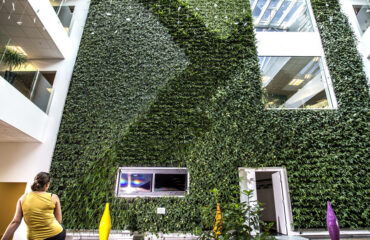
Living walls—walls covered by plants which do not root in the ground, yet root in soil or mats suspended on the wall itself—can be used on any scale to improve indoor air quality. But it’s not just in the area of health that living walls provide benefit. They also save energy, reduce noise, protect a building, serve as an art and architectural medium and can be used to grow food or medicinal plants.
Living walls – background
There are two types of living walls: with a substrate and without. The most used substrate is sphagnum, commonly called peat moss. Living walls can be adapted to almost any size.
Living walls have been used for centuries in Europe; whether this was an intentional use of living walls or a natural process of local fauna overtaking an available medium probably depended on the cultural status of the occupants. Today, living walls are re-entering the spotlight as an environmentally friendly way to improve air quality, reduce energy costs and bring nature back into the human landscape.
Health benefits
Living walls provide both physical and psychological health benefits. The plants use CO2 and circulate the air in the room, removing VOCs from the ambient air. This reduces the negative health effects associated with VOCs and poor indoor air. Living walls therefore improve air quality through photosynthesizing; absorbing CO2 and emitting oxygen.
Other Benefits
Reduce the heat island effect – the sun’s energy that’s used to reflect and radiate heat from buildings gets absorbed by the plants.
Increase the thermal performance of buildings (lowering energy consumption and costs) – shading from the plants on an exterior wall can decrease the temperature inside the building; lower temperatures indoors reduce the need for air conditioning.
Lower greenhouse gas emissions – by reducing indoor cooling demands, less energy is used and less GHGs are emitted.
741 Gali No.2, Arjun Nagar,
Gurgaon-122001, Haryana, India
CALL US NOW: